
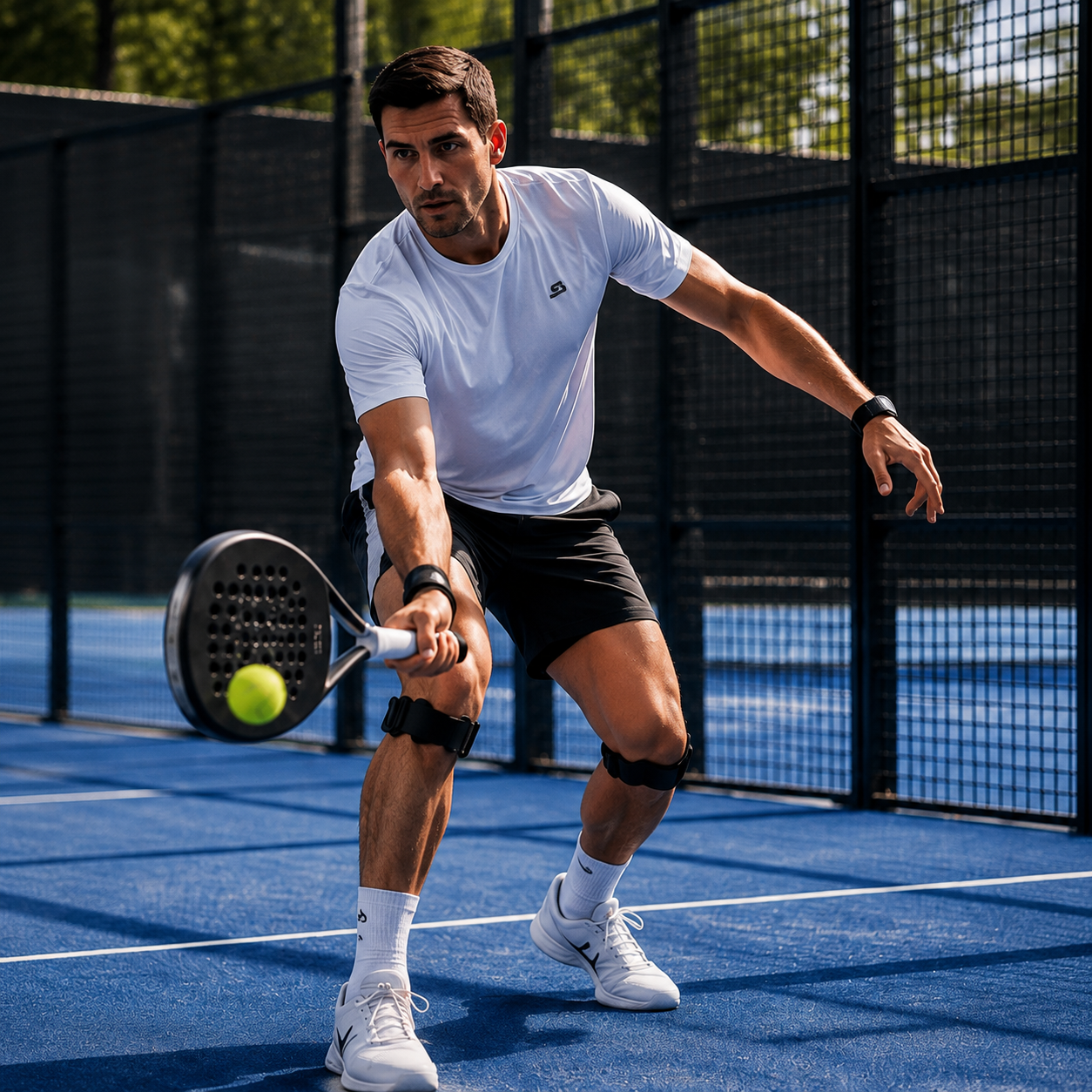
Padel, tennis, pickleball, badminton, squash: all great for fitness, coordination, and cardio. They combine speed, agility, and split second decisions, which is exactly what makes them fun and exactly what makes them tough on the body. Those same qualities put real stress on the knees. Whether you're playing for fun or competing regularly, protecting your knees matters if you want to keep showing up on the court and playing your best.
Unlike sports built around continuous forward motion, racket sports demand constant changes of direction. Players accelerate, decelerate, pivot, lunge, and jump over and over through a match. Every sudden stop or explosive burst sends force through the ankles, knees, and hips. Do that repeatedly without enough preparation and you end up with soreness, inflammation, or worse.
Strong muscles are the knee's first line of defense. Quads, hamstrings, glutes, and calves work together to stabilize the joint and absorb impact as you move. Well conditioned muscles take a lot of pressure off the knee directly. Weak or imbalanced muscles, on the other hand, lead to poor movement mechanics, and that raises the risk of discomfort during quick direction changes.
Technique matters just as much. Good footwork lets you reach the ball with controlled, balanced movement instead of an awkward lunge or a last second twist. Positioning your body correctly doesn't just improve your game, it takes unnecessary strain off your joints too. Small movement fixes often make a bigger difference than people expect, both for performance and for injury prevention.
A proper warm up should be non negotiable before stepping on the court. Dynamic stretches, light jogging, mobility work: all of it gets the muscles and joints ready for explosive movement while boosting blood flow and flexibility. Skip the warm up and your body simply isn't ready for sudden accelerations and sharp changes of direction.
Footwear deserves attention too. Every racket sport has its own movement demands, and shoes built specifically for court sports give you the grip, stability, and cushioning needed to support them safely. Worn out or wrong shoes quietly change your mechanics, adding stress to the knees with every rally.
Recovery matters as much as training itself. A hard match creates microscopic stress in the muscles and connective tissue, and that stress becomes strength during rest, not during play. Without enough recovery, fatigue starts affecting movement quality, and the muscles can't stabilize the knee as well as they should. Sleep, hydration, nutrition, and actual rest days keep the joints healthy across a season.
Strength training off the court is one of the smartest investments you can make. Exercises that build lower body strength, balance, and core stability improve your control during fast movements and take pressure off the knees. Consistent training builds the kind of resilience that shows up directly in how you move during matches.
Plenty of athletes also wear a supportive knee brace, especially during longer matches or coming back from an old injury. A properly fitted brace adds compression, improves joint awareness, and gives extra stability without limiting natural movement. It's never a replacement for good conditioning or solid technique, but it adds real confidence during demanding sessions.
It helps to know the difference between normal fatigue and joint pain. Feeling tired after a long match is completely expected. Persistent pain, swelling, instability, or discomfort that changes how you move is not, and shouldn't be ignored. Catching these things early prevents bigger injuries and less time away from the sport.
Racket sports run on speed, agility, and precision, and healthy knees are the foundation of all three. Strengthen the muscles supporting your joints, wear the right shoes, warm up properly, recover well, and move with good technique, and you'll cut the risk of knee pain while still enjoying the sports you love. Taking care of your knees now keeps you active, competitive, and confident on the court for years to come.

Leave a comment
This site is protected by hCaptcha and the hCaptcha Privacy Policy and Terms of Service apply.